
Ipê News #32 - Ipê Village is Live, Transhumanism and the Law on Thoughts
Your weekly update on what is happening in the Startup Society ecosystem.
Hey builders! Welcome to the 32nd edition of Ipê News.
🏘️ Community Updates
It's happening. Ipê Village 2026 kicks off in Florianópolis today for a month-long buildathon. Residents build the social, legal, and economic layers of a city together and own a piece of what they ship. Privacy House, AI House, Onchain House, Artizen House, 300+ apps as the target, demo day and techno party on May 1st.
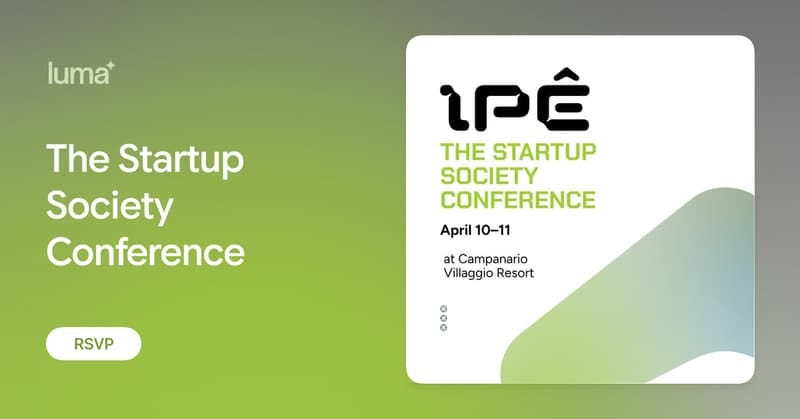
At the heart of the month: The Startup Society Conference at IL Campanario Villaggio Resort. Two days, 18+ speakers, four tracks: day one on governance and startup cities, day two on crypto and privacy, plus cross-cutting sessions on AI in decentralized decision-making, DAOs in city governance, and financing emerging cities through tokenization.
Confirmed speakers include Joyce Brand (The Morazan Model), Ingrid Barth (PilotIn), Fabio Seixas (Infinity Base), Valerio Leo (RayCash), Sebastian Brunemeier (Healthspan Capital), and Gerrit Glass (Open Health), among others. Holders of Explorer and Architect passports enter free. Full lineup and tickets at ipe.city.
🏫 Learning
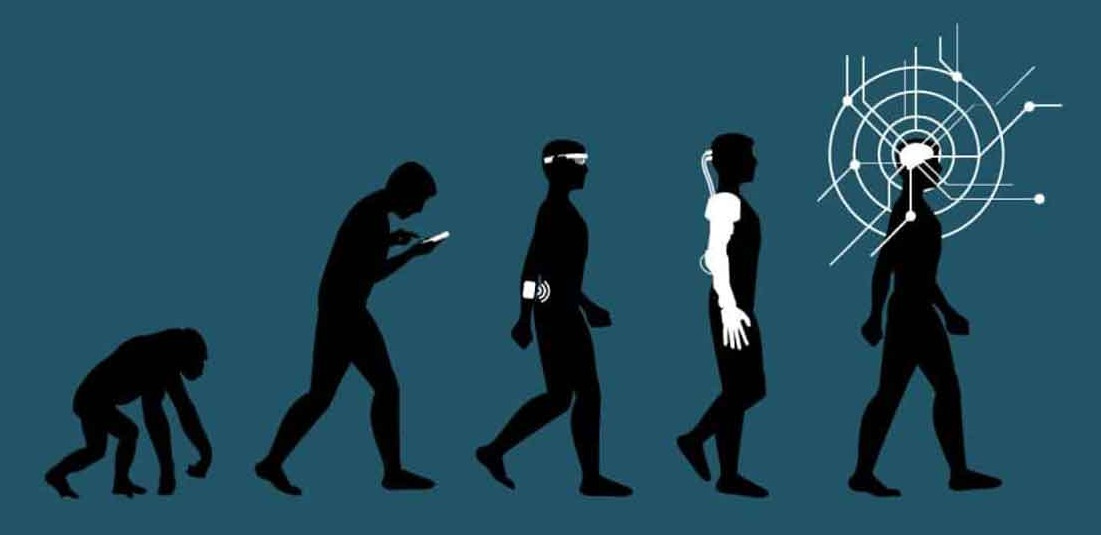
Transhumanism
Julian Huxley coined the term Transhumanism in 1957. The evolutionary biologist argued that humanity stood “on the threshold of a new kind of existence”: one reached by consciously pushing past biological defaults through science. The idea stayed mostly academic until the 1990s, when Max More’s Extropy Institute and later Nick Bostrom’s World Transhumanist Association gave it institutional form. Their 1998 declaration frames the ambition plainly: overcoming aging, cognitive limits, involuntary suffering, and confinement to Earth.
For most of history, the challenge was keeping humans alive. The frontier now is choosing what to add - lifespan, memory, and cognitive reach. Harari framed it as the upgrade from Homo sapiens to Homo deus: biology becoming a design surface rather than a given.
The practical side is already in motion. VitaDAO funds longevity science onchain; Zuzalu and Edge City build pop-up villages where biotech and neurotech sit inside daily life.
A techno-optimist reading treats that prospect as responsibility, the same impulse behind medicine and computation extended to the substrate we run on.
🌐 Parallel Communities and Cities
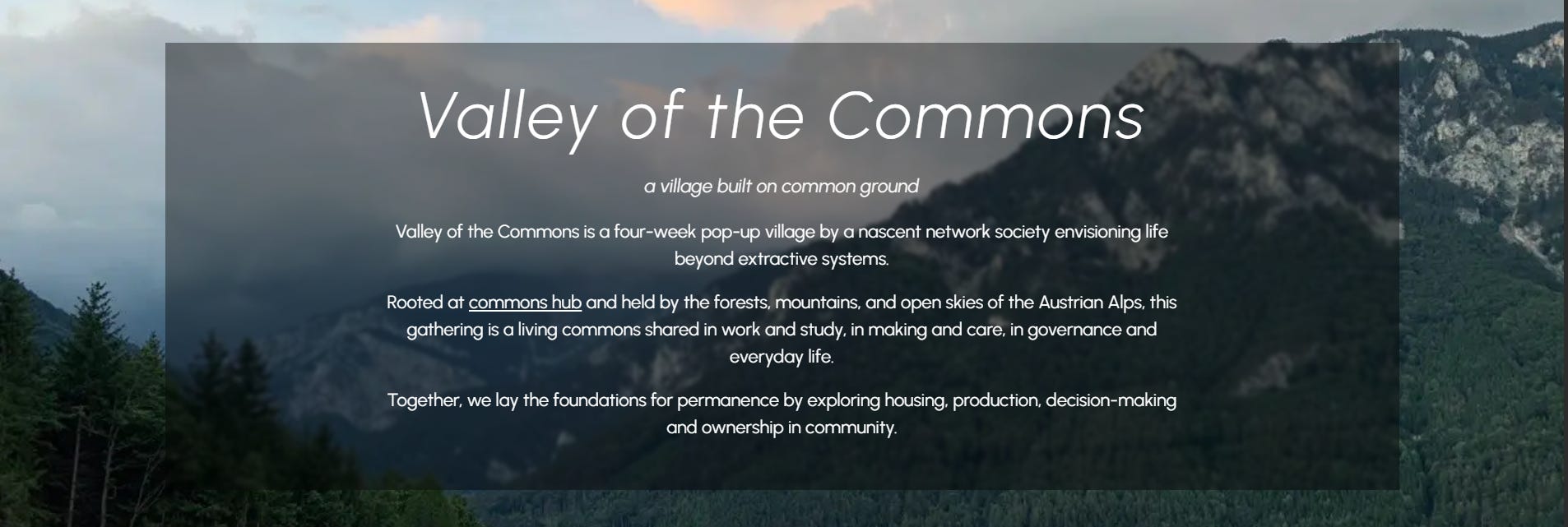
Valley of the Commons runs for four weeks at Commons Hub in Höllental, Austrian Alps - about an hour south of Vienna. The project is built for digital workers and remote professionals across Europe who want cooperative living beyond big-city isolation and the fragility of solo nomadism.
Week one opens with a five-day course on commons theory led by Michel Bauwens and Adam Arvidsson, followed by weeks on cosmo-local production, cooperative housing, and governance design. Mornings follow structured learning paths while afternoons shift to workshops and field visits.
The team previously co-organized Zu-villages and Invisible Gardens and sees this as preparation toward permanent settlement in a valley where real estate is still affordable and the landscape is largely untouched. Tickets start at €120 per week.
🛠️ Parallel Institutions
Wingbits - aviation DePIN on Solana, TGE April 22 #Parallel Institutions
Flight tracking depends on ADS-B receivers that hobbyists have operated for years, feeding data to aggregators like FlightRadar24 and FlightAware. These companies turned volunteer infrastructure into large revenue streams while offering operators little in return.
Wingbits reworks that model through a DePIN on Solana: station owners install WB200 receivers with roughly 250-mile range, upload cryptographically signed flight data, and earn $WINGS tokens. The network currently reports over 5,500 active stations and 15 billion daily data points.
Mainnet and TGE are set for April 22, with tokenomics including a revenue-linked buyback detailed in the documentation. This is an infrastructure read - for contract addresses, check only official Wingbits channels at launch.

Who Owns Digital Thoughts? - Stanford Law #Parallel Institutions
Neuralink patients are already playing video games and controlling computers using brain signals alone, and the company plans to scale implants through 2026. As consumer brain-computer interfaces grow, the neural data they produce is outpacing the old legal frameworks.
Standard consent assumes you know what you’re sharing, but neural signals yield inferences about emotional states and cognitive patterns the user never consciously disclosed. Researchers call this neuro-surveillance, and it runs deeper than behavioral tracking because the source is thought itself.
A normative response is forming around what scholars call the “neurorights” framework. The 2025 UNESCO Recommendation on the Ethics of Neurotechnology grounds freedom of thought and mental integrity as protections preceding consent, and several U.S. states have reclassified neural data as sensitive.
A Stanford Law analysis pushes further: if neural data becomes a transferable asset, its exchange could be normalized as a condition for employment, insurance, or service access. When the interface moves from your screen to your cortex, the question of who reads the data stops being theoretical.
🌍 Other Interesting News
The Arc Institute published Evo 2 in Nature this March, a 40-billion-parameter model trained on roughly nine trillion DNA base pairs from across all domains of life. To validate it, researchers asked the model to design a bacteriophage from scratch, synthesized the output, and it infected the intended host. The code is on GitHub under Apache 2.0, which puts that capability in any lab’s hands.
The BBNJ Agreement took effect after roughly fifteen years of negotiations and a 2023 final text. Officials describe the zone as two-thirds of the ocean and half the planet’s surface, with ratifications past eighty and a political target of thirty percent ocean protection by 2030 from a still-small baseline of protected area.
Several cancellations across NEOM, including Trojena work on dams, a lake, and a structure called The Bow plus tunneling tied to The Line rail, with combined terminated packages estimated above six billion dollars. Saudi Arabia is stepping back from hosting the 2029 Asian Winter Games at Trojena and a proposal to repurpose The Line as a large AI data center instead of the original nine-million-resident linear city.
💡 Join Ipê Village 2026
Ipê Village 2026 will be our next large-scale experiment exploring the future of communities, cities, and governance. Hosted in Florianópolis, Brazil, in March/April 2026, this pop-up city is open to founders, builders, creators, and techno-optimists.
Follow the journey and join the community on Twitter or Discord.