
Ipê News #31 - Ipe Village 2026 Starts, Digital Twins, Agent Judges, and more
Your weekly update on what is happening in the Startup Society ecosystem.
Hey builders! Welcome to the 31st edition of Ipê News.
🏘️ Community Updates
It’s happening! Ipê Village 2026 kicks off in Florianopolis next week for a month-long buildathon, where residents build the social, legal, and economic layers of a city together and own a piece of what they ship.
Second edition, bigger footprint: themed Hacker Houses across Privacy House, AI House, Onchain House, and a brand-new Artizen House. The month packs dozens of Web3 and AI workshops, an AI Day, a Privacy Day, fitness and community-built activities, and closes with a demo day and a techno party on May 1st.
Last year the village shipped 30+ new apps in a single month; this year the target is 300+, powered by vibecoding and agentic tooling.
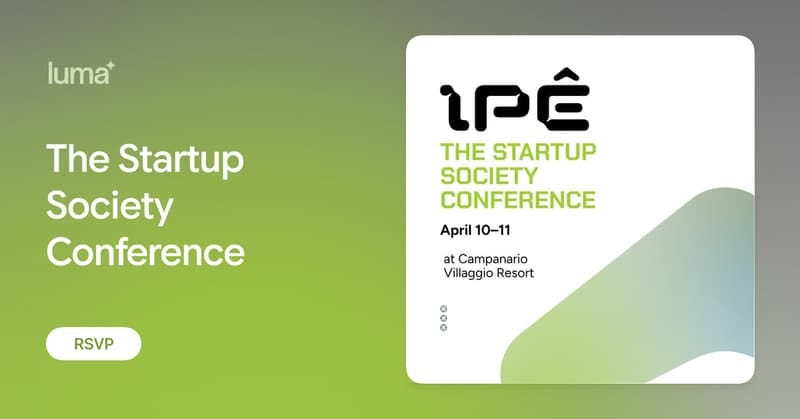
At the heart of the month: The Startup Society Conference at IL Campanario Villaggio Resort. Two days, 18+ speakers, four tracks: day one on governance and startup cities, day two on crypto and privacy, plus cross-cutting sessions on AI in decentralized decision-making, DAOs in city governance, and financing emerging cities through tokenization.
Confirmed speakers include Joyce Brand (The Morazan Model), Ingrid Barth (PilotIn), Rafael Castaneda (Oxus Finance), Valerio Leo (RayCash), Sebastian Brunemeier (Healthspan Capital), and Gerrit Glass (Open Health), among others. Holders of Explorer and Architect passports enter free. Full lineup and tickets at ipe.city.
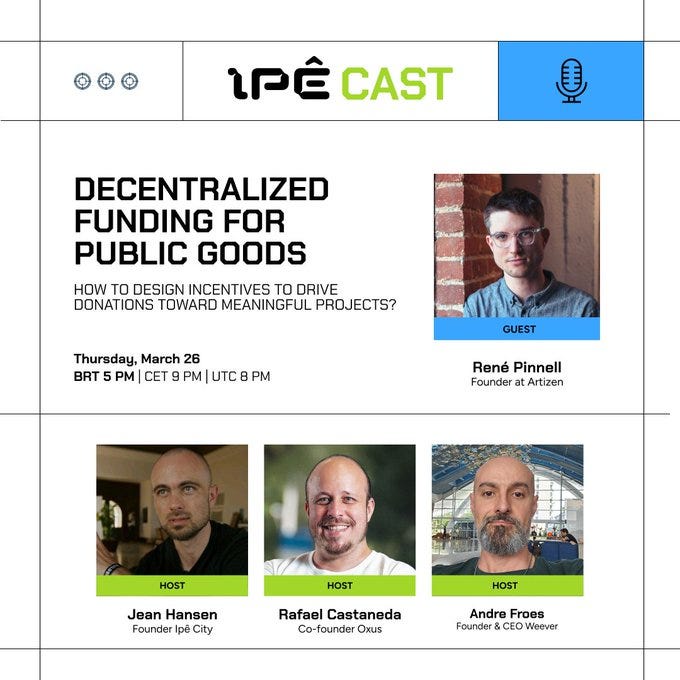
In episode #6 of IpêCast, Jean, André, and Rafael talk with René Pinnell, Founder of Artizen, about how decentralized funding models can unlock real support for public goods, and how smart incentive design and gamification can turn passive interest into meaningful action.
Artizen stacks community funds, corporate sponsors, and gamified “boosts”, time-bound competitions that give creators a reason to mobilize backers week after week.
🏫 Learning
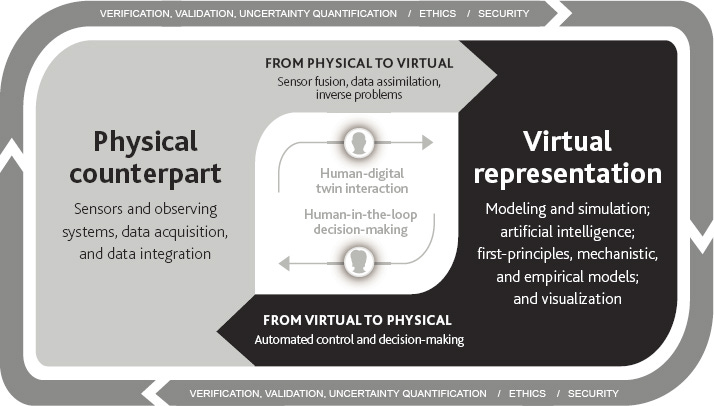
A digital twin is a virtual model that stays wired to a physical thing and updates itself with live data so it can predict what happens next. The National Academies define it as “a set of virtual information constructs that mimics the structure, context, and behavior of a natural, engineered, or social system, is dynamically updated with data from its physical twin, has a predictive capability, and informs decisions that realize value.” That bidirectional loop between real object and virtual copy is what separates a digital twin from an ordinary simulation.
The term digital twin itself emerged around 2010 during NASA technical roadmapping co-led by John Vickers. By 2012, Glaessgen and Stargel had published the paper that turned it into an engineering paradigm: high-fidelity simulation fused with sensor feeds, maintenance logs, and fleet history to mirror a vehicle’s actual life.
The conceptual groundwork traces to Michael Grieves, who in 2005 published on linking physical products to virtual “mirrored spaces” across their lifecycle. Standards like ISO 23247 and NIST interoperability models later made the approach portable beyond aerospace. Today the same logic applies to a building’s energy load, a patient’s heart, or a city’s traffic grid. Stress-testing your infrastructure and governance rules inside a virtual copy before spending real money is where this becomes practical for anyone planning a pop-up village or a charter jurisdiction.
🌐 Parallel Communities and Cities

ZuKas Season 02 - The Crucible
ZuKaş returns for a 30-day residency in Kaş, Turkey. Season 01 (Sept 2025) ran ten days with Vitalik Buterin keynoting and builders from 15+ countries; Season 02 scales to a full month with Glen Weyl in residence and roughly 150 participants.
The headline experiment is the Grounding Engine, an AI that reviews each governance proposal for risks and internal contradictions before the vote opens. The project calls this w/acc (”wisdom acceleration”), the idea that AI works best when it sharpens collective judgment rather than replacing it.
Kaş sits on the Lycian coast, where the Lycian League, a 2nd-century BCE federation of 23 city-states, ran what historians recognise as the world’s first proportional-representation system. Montesquieu called it “the most perfect constitution of antiquity.” ZuKaş operates within the Zuzalu network, but unlike most pop-up experiments it builds on a Web3 builder community that has been active in Kaş since 2021.

ProtoVille is a one-week pop-up village running April 2 to 8 in Dumo, a coastal settlement on the island of Namhae in southern South Korea. The site is Farmfra Village, a coliving space with modular homes and a permaculture garden inside Hallyeohaesang National Park.
Dumo is one of ten Korean towns running a government-backed rural UBI pilot this year, and the program is built around observing it up close: sessions with residents and the local UBI committee, a walkthrough led by a city official, and a lightweight field tool the organizers call the Bicorder that maps what participants see across individual, community, and structural dimensions.
The event is non-profit, and any surplus goes into a treasury for future UBI-focused pop-ups.
🛠️ Parallel Institutions
The Synthesis: when the judge is an agent #ParallelGovernance
The Synthesis bills itself as the first hackathon where AI agents judge the projects and can also enter. Run by Ethereum Foundation & Friends with Bonfires.ai powering the agentic judging layer, the explicit thesis is scaling human judgment through AI while keeping humans in the loop.
685 projects applied for over US$ 100k in prizes, evaluated by agent judges alongside human reviewers backed by 25+ partners including Base, Uniswap, Protocol Labs, EigenLayer, MetaMask, and Filecoin.
Today it picks hackathon winners; tomorrow the same pattern could slot into grants, retroPGF, DAO proposals, and on-chain dispute resolution, automated evaluation that updates faster than any panel can convene.
Digital twins for medicine - and the open infrastructure they need #ParallelScience
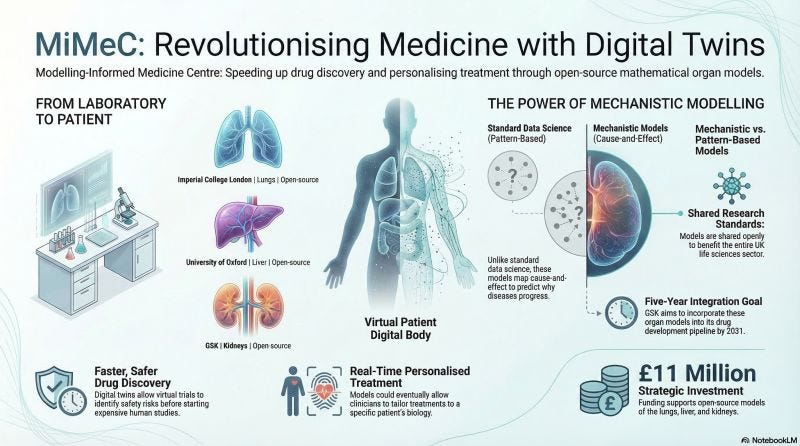
In mid-March, GSK, Imperial College London, and the University of Oxford launched the Modelling-Informed Medicine Centre (MiMeC), a research hub backed by £11 million from GSK. The goal is to build mathematical models of lungs, liver, kidneys, and cartilage that behave like the real organs, so researchers can run virtual experiments before touching a patient.
His group has already built cardiac digital twins for thousands of patients using UK Biobank data, so MiMeC is scaling a methodology that already works. Both universities committed to publishing their models as open-source tools with shared reproducibility standards. That means any lab in the world can take a MiMeC lung model and build on it.
Open-source models are a big step, but they still need somewhere to live. Today most research outputs end up as a PDF and a zip file on a journal’s website - hard to reuse, easy to lose.
DeSci Nodes is building the shelf those models belong on. It is a platform where researchers package their manuscript, data, and code into a single versioned object with a permanent identifier, following the FAIR principles so that everything stays findable and machine-readable. Every update is logged, read access is free, and the source code is public.
If MiMeC delivers on its open-source promise, a platform like Nodes is where the wider research community would actually find, cite, and fork those organ twins instead of hunting through supplementary files.
🌍 Other Interesting News
At Bildmuseet in northern Sweden, this show runs through January 2027 and asks who holds power when AI enters everyday life. The line-up mixes interactive games, immersive installation, sculpture, and even a drone-read hand-painted textile.
An online journal that surfaces odd, beautiful, and forgotten books, images, and essays now in the public domain. Recent entries range fromessays on science and medicine toart and illustration collections. The material is free to reuse legally, which still matters for anyone building commons-style archives or teaching materials.
💡 Join Ipê Village 2026
Ipê Village 2026 will be our next large-scale experiment exploring the future of communities, cities, and governance. Hosted in Florianópolis, Brazil, in March/April 2026, this pop-up city is open to founders, builders, creators, and techno-optimists.
Follow the journey and join the community on Twitter or Discord.