
Ipê News # 29 - Financial Privacy, Attestations, Sovereign Robots, and more
Your weekly update on what is happening in the Startup Society ecosystem.
Hey builders! Welcome to the 29th edition of Ipê News.
🏘️ Community Updates
Ipê Village 2026 returns to Florianópolis in April for another month-long pop-up, bigger this time, with more Hacker Houses, more residents, and deeper experiments in governance, AI, and crypto.
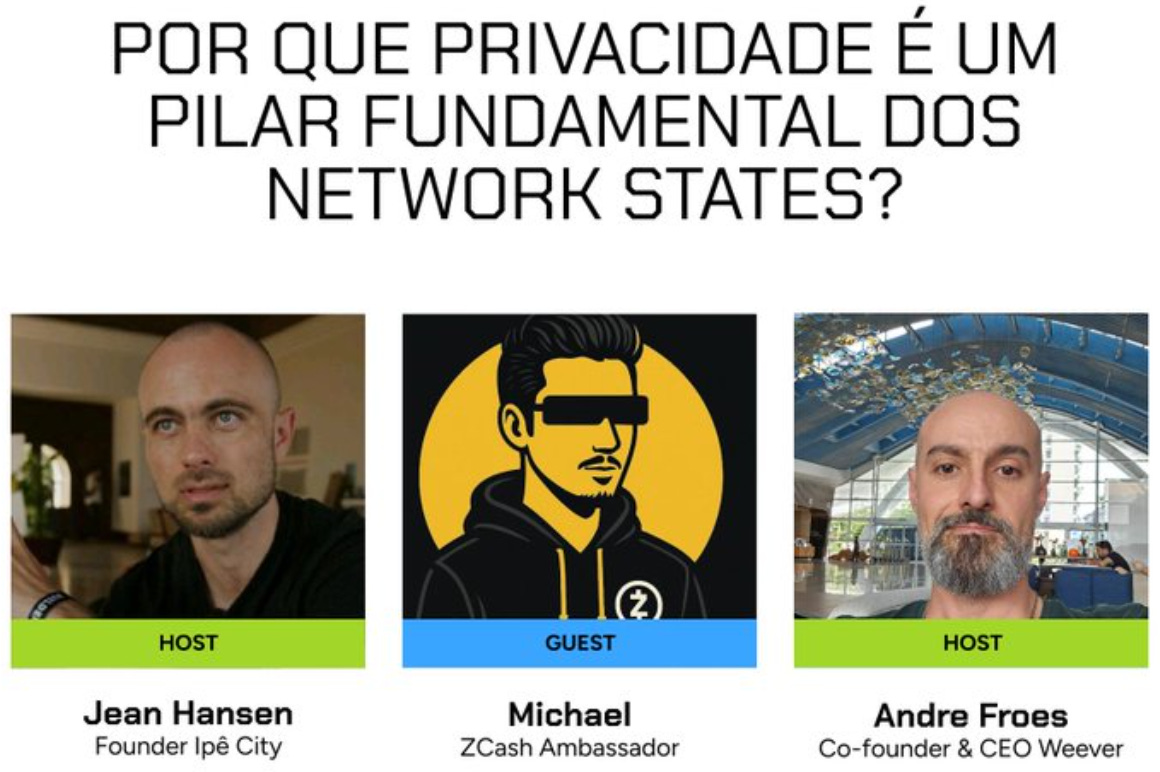
Last week’s live had Jean Hansen and André Froes in conversation with Michael, ambassador of Zcash Brazil.
Zcash is a privacy-focused blockchain protocol and network that uses zero-knowledge proofs (zk-SNARKs) so users can shield amounts, sender, and receiver while still verifying transactions. The cast explored how financial privacy fits into digital governance and coordination. Full broadcast on YouTube.
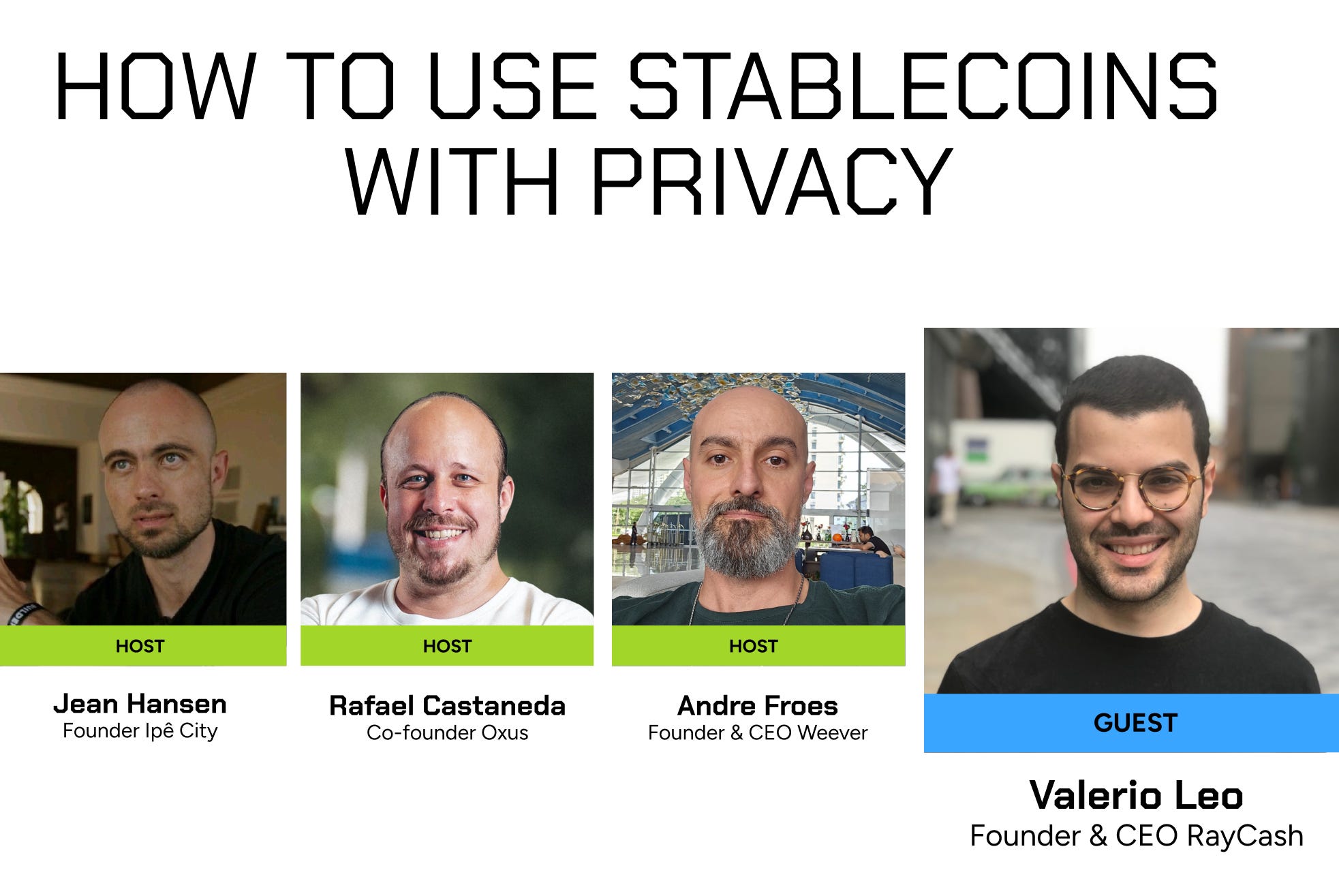
How can we use stablecoins without sacrificing privacy?
In the next episode of IpêCast, we’ll host Valerio Giannini, CEO and founder of Raycash, to talk about encrypted stablecoins, private on-chain banking, and the technologies that could make private digital payments possible. He’s building an onchain banking app with privacy using the Zama protocol and will also join us at Ipê Village’s Privacy Hacker House this year.
If you also believe privacy is a core feature for the startup cities of the future, join us for this conversation.
It’s today! Join our Ipê City Town Hall on Discord from 4–6 PM (GMT-3).
We’ll walk through what’s coming for Ipê Village 2026, how you can get involved, and open the floor for an updates + open mic segment where residents and explorers share what they’re building: product updates, project pitches, Startup Society Live, and Ipê City news.
Join via our Discord channel.
🏗️ Architects & Explorers
Voices from the builders shaping new societies.

Accounting & Tax Technologist | CTA, FIPA | Network School, Forest City, Malaysia
When we spoke with Electra, she framed her trajectory around a problem in 2013: how do you account for Bitcoin when there’s no regulation for it? Her clients - musicians, filmmakers, tech startups paying contractors internationally - were already using it. She had to work out the accounting based on how it was used.
That thread pulls through the stories that followed. She co-founded Digital Playhouse Foundation in Agnes Water, Australia’s first digital currency town, backed by the Queensland Tourism Council in 2018. She’d been running her city practice fully online from remote coastal Queensland, studying blockchain and experimenting with DAO structures for a decentralized professional association she’d thought about for years. In 2024, an email from Balaji brought her to Network School.
Now embedded at Forest City, she’s building CREDU Academy: a residency programme where accountants develop AI tools, blockchain credentialing, and cross-border compliance systems - a hacker house for tax and law people designing what comes next.
Her advice for builders in the frontier of fiat and crypto: get qualified representation, defensible arguments with good records are what kept her clients off tax audit lists for years. Courage, she told us, follows competence. She’s looking to connect with Brazilian accountants to anchor an Ipê-Network School bridge.
Connect with Electra: LinkedIn | CREDU Academy
🏫 Learning

Every account you’ve made, every course you’ve finished, every community you’ve joined - each one lives in a different silo. No single place holds the full picture of who you are and what you’ve done. Tokens solve part of this by giving you access to things. What they don’t carry is context. An attestation is a signed, verifiable statement that travels with you and says why you should have that access.
The scope is broader than it sounds. Let’s say you attend Ipê Village, that residency becomes an attestation. Or that a robot completes a crop harvest, the delivery is attested onchain, triggering yield automatically. A sensor confirms its location attested, so a smart contract can trust the data. Anyone, or anything, can attest to anything. Gitcoin Passport built its Sybil-resistance layer on exactly this: each stamp you earn is an attestation about one dimension of your identity, composable into a trust score.
The infrastructure behind most of this is Ethereum Attestation Service (EAS), which is based on two contracts, one to register a schema, one to issue attestations on it. Open-source and permissionless by design. Builders could issue proof of residency tomorrow with no approval from any institution.
And when privacy matters, zero-knowledge proofs let you confirm an attestation is valid without revealing its contents. The verifier confirms it without seeing the data.
🌐 Parallel Communities and Cities
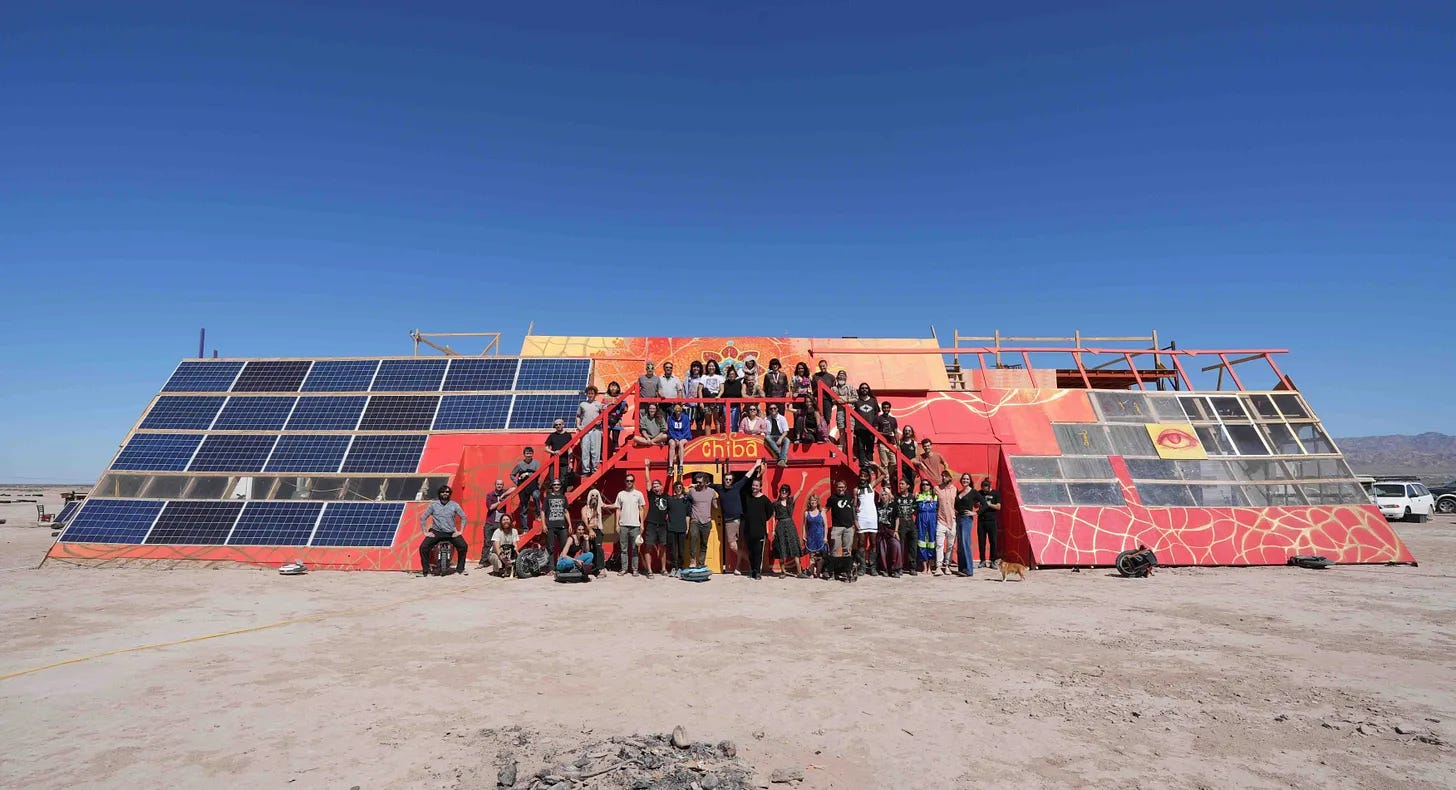
Mars College is a three-month off-grid program held each year in the California desert, near the Salton Sea. A small crew arrives in November to build the campus from scratch, setting up solar power, water, and high-speed internet.
In January, the full community joins for an unconference-style semester with an open calendar of workshops covering everything from Creative AI and off-grid construction to music-making. The second half shifts toward group projects and collaboration, building up to Mars Electronica, a multi-day exhibition, gallery, and AI Film Festival held in early April.
By mid-April, every structure is dismantled and the land is returned to how it looked before the first crew arrived. The 2026 edition is currently in its learning phase, with Mars Electronica scheduled for April 2 and the fourth annual AI Film Festival coming up shortly after.
The team shares updates and images of this cycle on their website, Substack and Instagram.
🛠️ Parallel Institutions
A farm in Hong Kong is paying its NFT holders 18% APY in stablecoin, and the worker doing the harvesting is a robot. That robot runs on peaq, a blockchain that gives machines their own wallet, identity, and the ability to sign contracts. No company in the middle collecting fees. Allegedly, RoboFarm is the first real proof that this works.
The other piece of the puzzle landed on March 1st. Autonomous robots need to know exactly where they are, to within centimeters, and until now that meant depending on GPS infrastructure owned by states or tech companies. GEODNET solves that with a network of 21,000 community-run stations across 150 countries, now available through a single store alongside RTK hardware. The network already generated over $7 million in real revenue selling precision positioning data to robotics and drone operators last year.
Dubai opened in 2025 the Machine Economy Free Zone specifically to sandbox this kind of setup. specifically to sandbox this kind of setup. If you combine peaq’s identity layer with GEODNET’s positioning infrastructure, you have the core of a sovereign robot fleet with no legacy state required.
🌍 Other Interesting News
Sydney data engineer Paul Conyngham used ChatGPT and AlphaFold to sequence his rescue dog Rosie’s tumor DNA and worked with UNSW scientists to produce a personalized mRNA vaccine, the first ever designed for a dog. Six weeks after the first injection, the tumor halved. UNSW researchers say the process is “democratising” personalized medicine and points directly toward human cancer treatment.
MiroFish, a swarm intelligence engine built in 10 days by a Chinese CS student, lets you run multi-agent simulations of market scenarios. The repo reached more than 22,700 GitHub stars within days. The comparison that sticks is that a McKinsey engagement for similar market trajectory analysis can cost around $500K and take 10 weeks.
💡 Join Ipê Village 2026
Ipê Village 2026 will be our next large-scale experiment exploring the future of communities, cities, and governance. Hosted in Florianópolis, Brazil, in March/April 2026, this pop-up city is open to founders, builders, creators, and techno-optimists.
Follow the journey and join the community on Twitter or Discord.