
Ipê News #27 - Anthropic vs. the Department of War, ZuCity Japan, and more
Your weekly update on what is happening in the Startup Society ecosystem.

Hey builders! Welcome to the 27th edition of Ipê News.
🏘️ Community Updates
Ipê Village 2026 returns to Florianópolis in April for another month-long pop-up, bigger this time, with more Hacker Houses, more residents, and deeper experiments in governance, AI, and crypto. Join the Telegram group.
Episode #2 of IpeCast was live last week with Jackson Steger, Founding Director of Network School, hosted by Jean Hansen and André Freys. Full session on YouTube.
This Thursday, March 5, Michel Bauwens joins for a conversation on commons-based governance and peer-to-peer alternatives to the nation-state. Bauwens founded the P2P Foundation and spent two decades building the intellectual scaffolding themes like commons-based peer production, cooperative economics, the idea that communities can govern shared resources without states or corporations in the middle. Event Link: https://luma.com/eydzg9q7
🏫 Learning
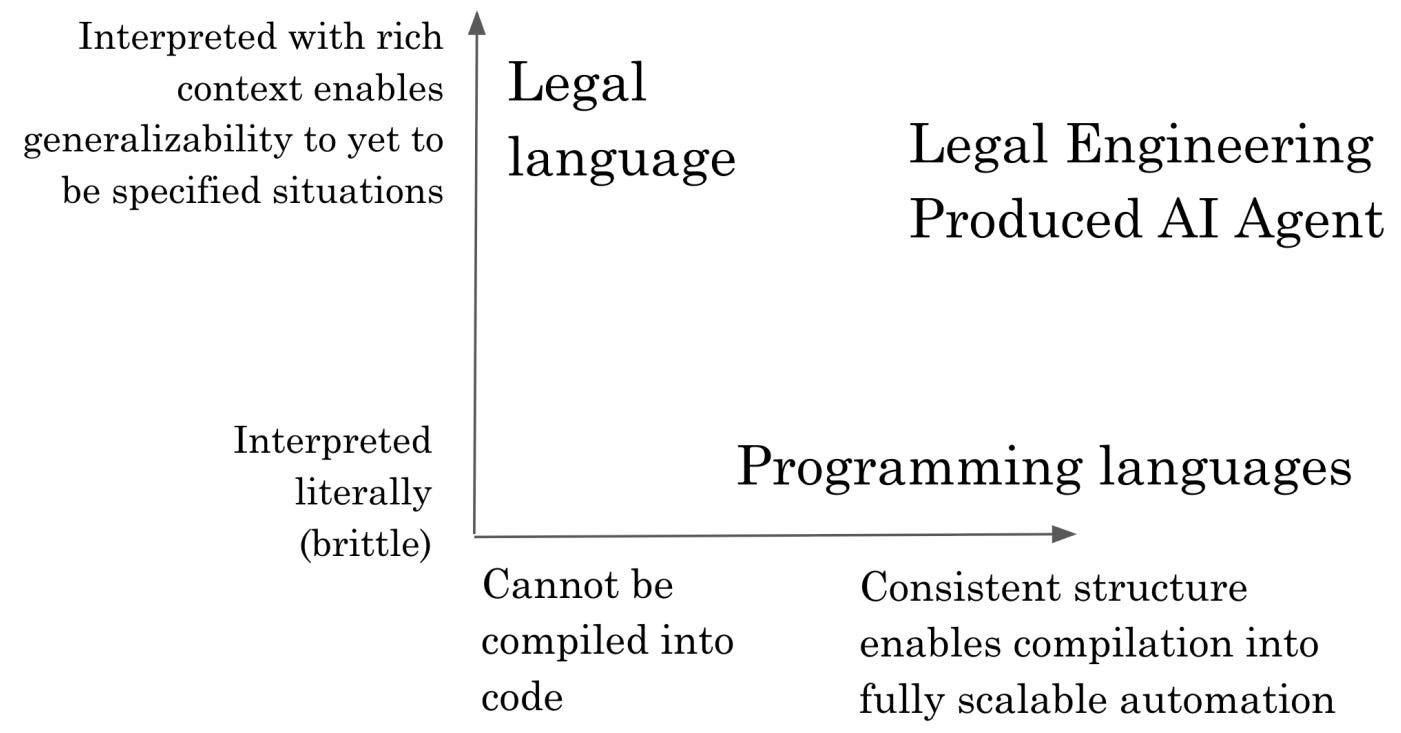
Law has always been an algorithm. The Code of Hammurabi, written around 1750 BC, is structurally a chain of if-then statements: if this act is committed, then this consequence follows. For four thousand years, only humans could execute legal code. Legal Engineering is the discipline built on the premise that this is no longer necessary, or sufficient.
The concept has been advanced through research affiliated with Stanford’s CodeX and is operationalized by Norm AI through its Legal Engineering Automation Platform (LEAP). Attorneys without coding experience use LEAP to transform regulations workflows into AI agents without a software engineer in the loop. The resulting system completes the first pass of a legal analysis autonomously.
And what happens when the regulation changes, or the agent encounters a situation no one anticipated? MIT’s Computational Law group has been working on this from a different angle. Their ETLC framework (Extract, Transform, Load, Compute) uses Bayesian networks to let an agent reason under uncertainty rather than fail on edge cases.
Legal Engineering doesn’t replace legal judgment. It makes compliance computable.
🌐 Parallel Communities and Cities

In 2025, Kiba Gateaux bought four houses in a rural Japanese mountain village, all within a five-minute walk of each other. No grants, no investors. The first ZuCity popup event broke even on ticket sales alone (¥480,000, roughly $3,200), with 26% immediately converted into a car and furniture. Forty-four people came through the year. A local school building is now under negotiation with the city government as the fifth property.
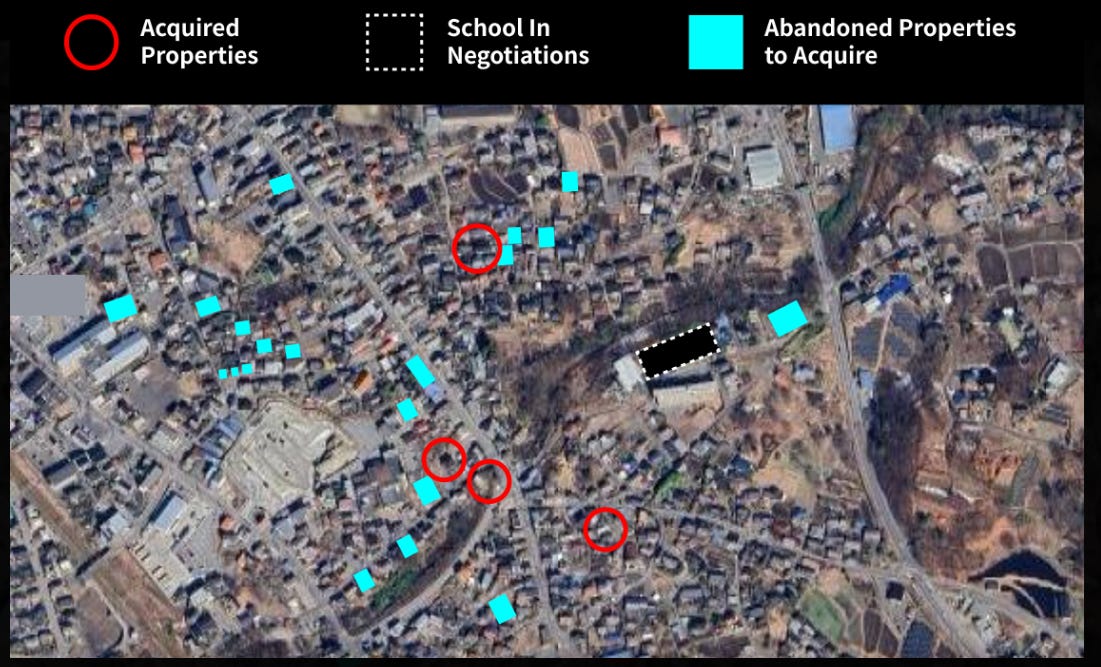
Each property acquisition is a share in the neighborhood. ZuCity’s aesthetic is equally specific, wabi-sabi, satoyama, and mottainai as the base layer, cypherpunk, neo-ruralism, and transhumanism on top. Not foreigners escaping modernity, but people building something with deliberate cultural grammar in Japan’s massive stock of abandoned homes (roughly 15% of all housing in the country).
The March 2026 popup opens the process to newcomers. Workshops cover property scouting and acquisition, DIY renovation, Japanese language and culture, farming, home cooking, and SEZ frameworks in Nagano. Community tokens are on the agenda too.
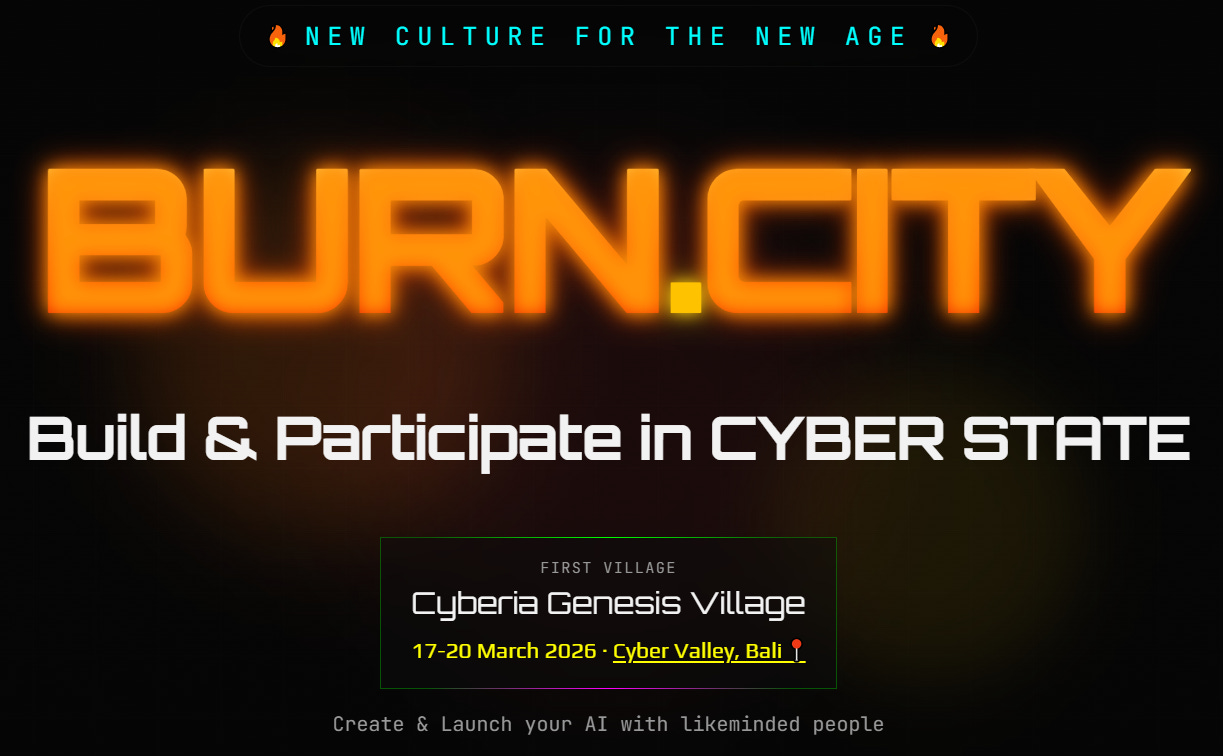
Cyber Valley is building burn.city with a different first resident: not humans, but AI agents. Sensors, data pipelines, and feedback loops embedded in real land give AI systems something they don’t typically have access to, closed-loop learning from actual physical environments. Real soil, real weather, real energy systems. Humans serve as operators, renting the land by the hour, day, or week, executing what the agents surface and measuring what happens. The first shift is March 17-20, 2026. Shared living runs around $2,000/month; private, $3,000/month.
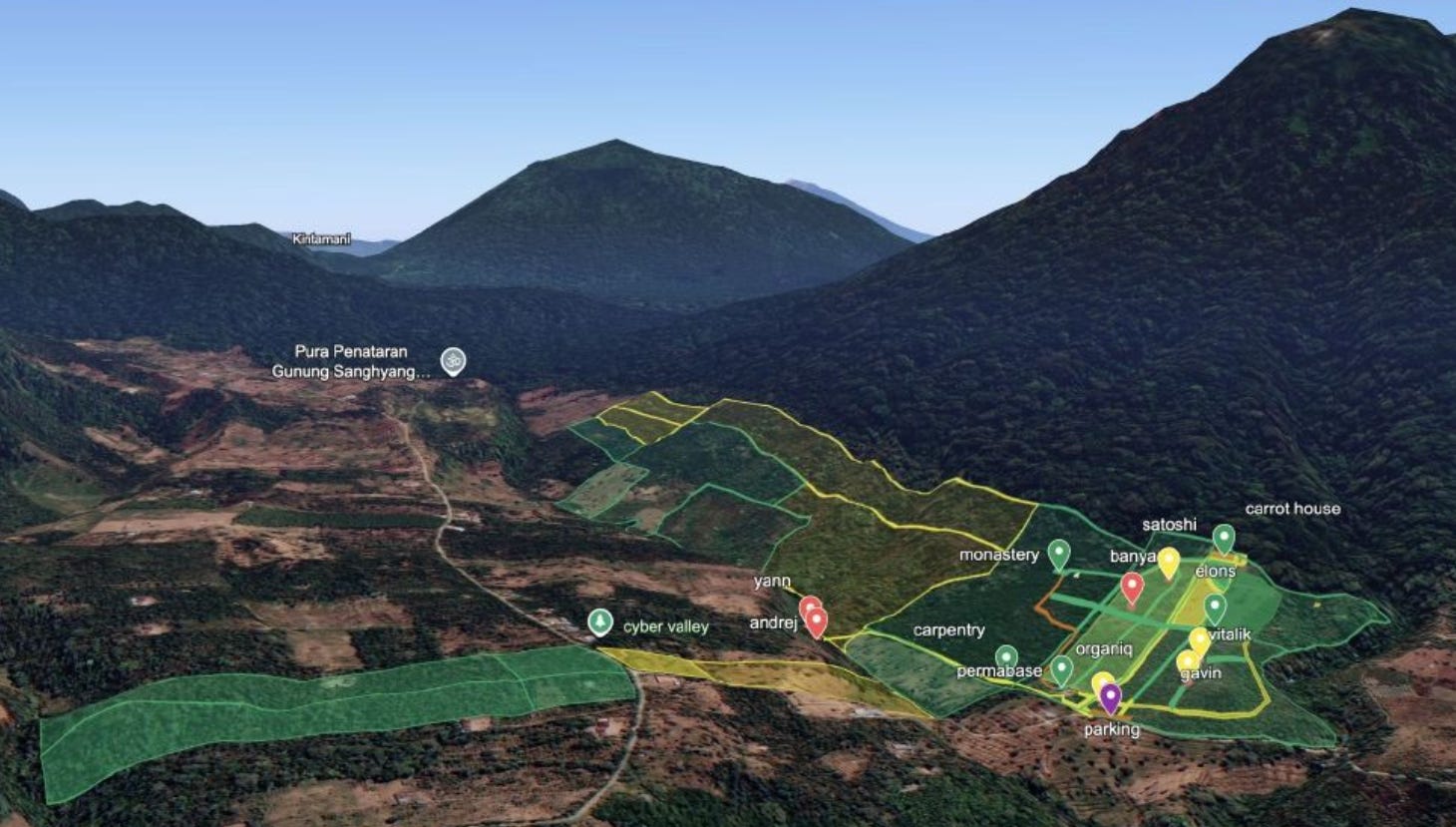
The argument Cyber Valley makes is that AI depends on electricity, minerals, and a stable planet. If the physical infrastructure destabilizes, the digital infrastructure goes with it. “Mutual dependency isn’t philosophy, it’s a dependency graph,” as they frame it. Most projects in this space treat the physical world as backdrop. burn.city treats it as the training environment.
🛠️ Parallel Institutions
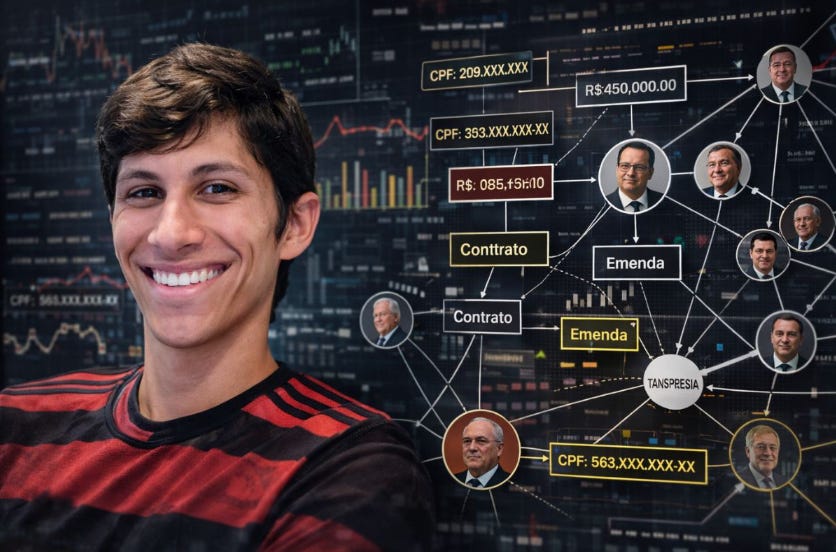
A developer named Bruno appeared on X with a demo that stopped timelines cold. He had built an AI agent system capable of cross-referencing open government databases (procurement records, contracts, suppliers, public spending) and surfacing patterns that, statistically, look like corruption. No leaks. No insider sources. Just data that was technically public all along, finally being read at machine speed.
These databases have been sitting on a shelf for decades, everything catalogued, in order. The bottleneck was never access. It was reading speed. What Bruno is trying is to bridge the gap that made corruption investigations take years. Bruno pushed the code. br/acc is now live on GitHub, open source, with 995 stars and 258 forks on release day. Version 0.4.0 cross-references 39 Brazilian public databases.

Dario Amodei, from Anthropic, refused two specific uses of Claude for what the Trump administration now officially calls the “Department of War”: mass domestic surveillance of American citizens and fully autonomous weapons. The DoW’s response was to escalate to the top. Secretary Pete Hegseth designated Anthropic a “supply chain risk,” a label historically reserved for foreign adversaries and never before applied to an American company. Trump ordered all federal agencies to stop using Anthropic technology, with a six-month phase-out for ongoing deployments.
Amodei is betting the company’s federal revenue on principles he calls non-negotiable, arguing that today’s frontier AI is not reliable enough for autonomous weapons and that mass surveillance violates democratic values. Hegseth and the DoW want unrestricted operational flexibility, “all lawful uses” without private-sector carve-outs. OpenAI walked in hours later with its own Pentagon deal, with “claimed safeguards” whose robustness has yet to be tested under pressure.
Amodei was unambiguous: "No amount of intimidation or punishment from the Department of War is going to make us change our stance. We will fight any supply-chain risk designation in court." Individual customers, commercial API contracts, and every other use remain completely unaffected.
🌍 Other Interesting News
Property-rights economist Hernando de Soto, champion of formalizing informal economies, appointed Prime Minister of Peru, putting his life's work on property formalization and legal recognition of the informal sector directly in the hands of government.
OpenClaw, a personal AI assistant, just surpassed React on GitHub stars, overtaking the library that powers half the internet. The project shipped 90+ changes on the same day React's team shipped a conference.
💡 Join Ipê Village 2026
Ipê Village 2026 will be our next large-scale experiment exploring the future of communities, cities, and governance. Hosted in Florianópolis, Brazil, in March/April 2026, this pop-up city is open to founders, builders, creators, and techno-optimists.
Follow the journey and join the community on Twitter, Telegram or Discord.