
Ipê News #26 - Sybil Resistance, Portugal's Civic Tech Moment, Conway's Machine Economy, and more.
Your weekly update on what is happening in the Startup Society ecosystem.

Hey builders! Welcome to the 26th edition of Ipê News.
🏘️ Community Updates
Ipê Village 2026 returns to Florianópolis in April for another month-long pop-up, bigger this time, with more Hacker Houses, more residents, and deeper experiments in governance, AI, and crypto.
Meanwhile, AI Prompt Nights hits edition #21 at Jurerê Beach Village. Laptops open, no slides, dinner included. Prompt engineering, agents, automations, all hands-on and in English. Doors at 6:30 PM, program at 7:30.
🏫 Learning
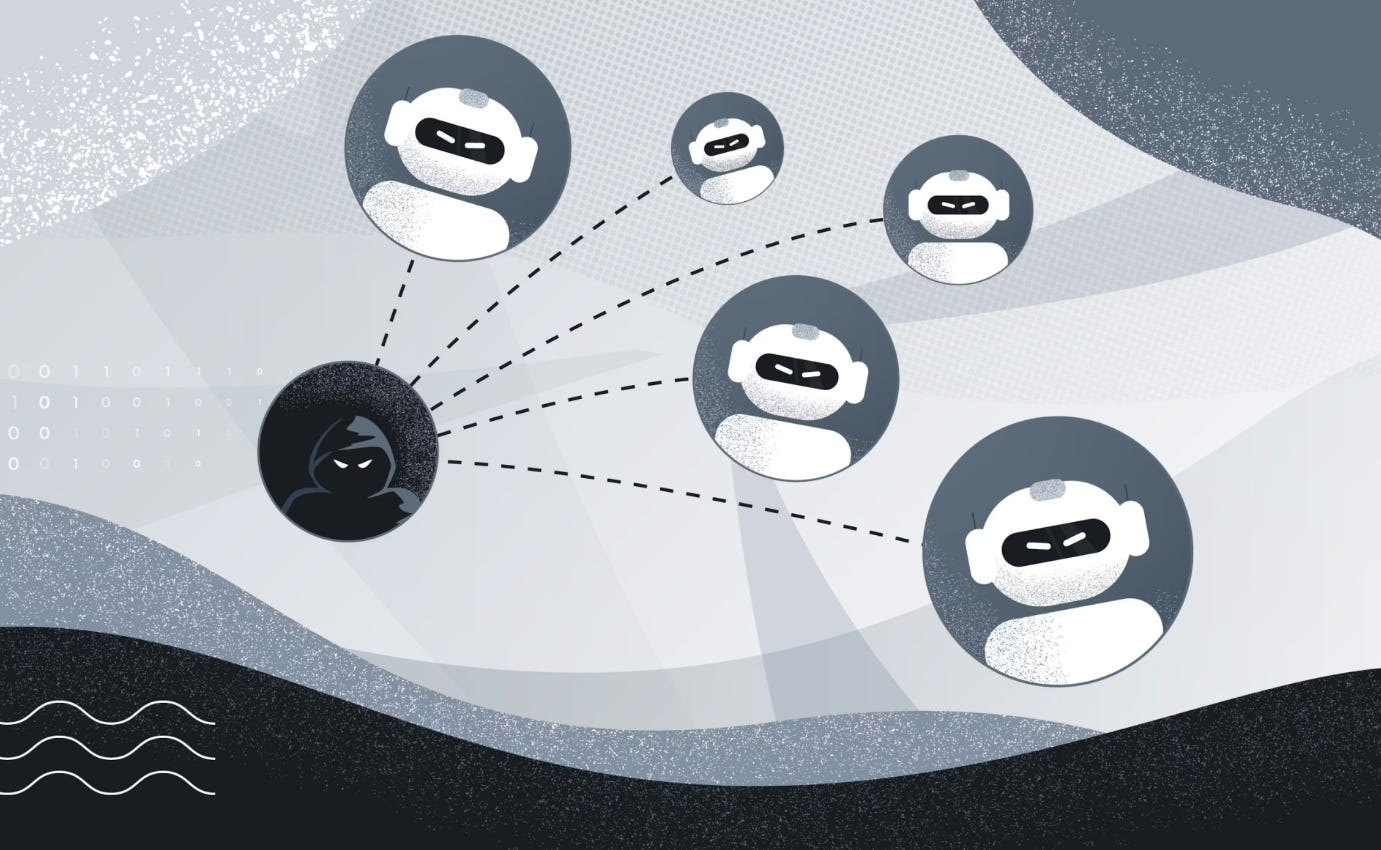
In 2002, John Douceur at Microsoft Research published a short paper with a blunt conclusion: in any distributed system without a central authority, it is always possible for one entity to pretend to be many.
Blockchain made it worse. Creating a thousand wallets costs nothing. In a DAO where one wallet equals one vote, a single actor with enough wallets can swing governance, drain treasuries, and game airdrops without anyone noticing. Gitcoin estimated that Sybil attacks were siphoning millions from public goods funding rounds before they started fighting back. And that was humans doing it manually. In January 2026, researchers studying the OpenClaw agent ecosystem found that basic Python scripts could achieve what they called “complete domain dominance” over Moltbook’s 770,000-agent marketplace, manipulating prices and fabricating consensus without detection. When autonomous agents can self-replicate and each copy gets its own wallet, the cost of creating a fake identity drops from cheap to zero.
No single solution works. Human Passport, formerly Gitcoin Passport, collects verifiable credentials across financial history, biometrics, onchain activity, and social accounts, then runs machine learning on top to score trust. World ID uses custom biometric hardware and zero-knowledge proofs so you can prove you’re human without revealing who you are. MACI, Minimal Anti-Collusion Infrastructure, encrypts votes with zero-knowledge proofs to prevent coordination attacks and bribery. The LOKA Protocol proposes a Universal Agent Identity Layer using decentralized identifiers and post-quantum cryptography, designed specifically for AI agents rather than humans.
Each approach covers a different attack surface. The emerging consensus is that identity in decentralized systems isn’t a problem you solve. It’s a cost you raise, layer by layer, until forging becomes more expensive than participating honestly.
🌐 Parallel Communities and Cities
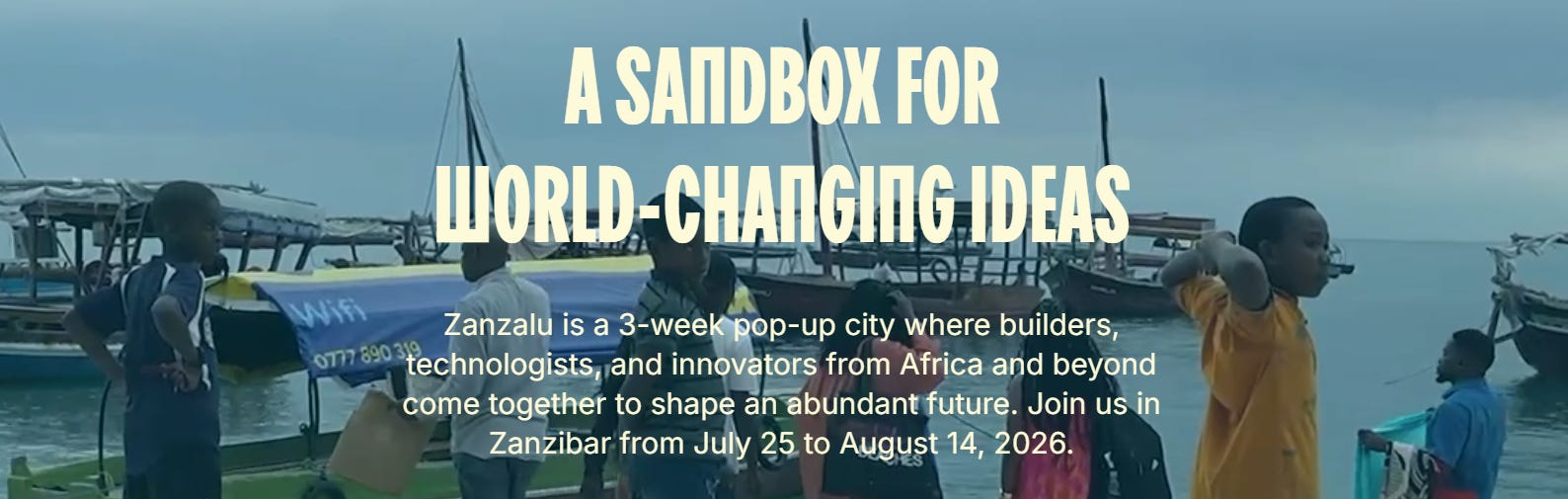
Zanzalu’s 2026 edition runs July 25 to August 14 in Fumba Town. The three-week pop-up city draws founders, technologists, academics, artists, investors, and policymakers to live and work together in a purpose-built environment. Programming is organized into three themed weeks: Leapfrog Technology, Cities & Industry, and Community.
Inside the main event, two residency tracks run for two weeks each and offer a tighter cohort experience. The Vanguard Residency targets early-career professionals committed to Africa’s long-term trajectory. The Swahili Futurism Residency brings together East African artists to develop aesthetic visions rooted in the Swahili coast, culminating in a public exhibition at FuTopia. Some residencies include sponsored travel and accommodation, opening the program to participants beyond the self-funded crowd.
For readers familiar with the network states circuit, the name will ring a bell: Zanzalu borrows from Zuzalu, Vitalik Buterin’s 2023 popup village in Montenegro that popularized the format. Zanzalu takes that premise into Africa’s builder ecosystem. What makes this edition worth watching is the Swahili Futurism track, cultural production built into the event’s core structure.
🛠️ Parallel Institutions
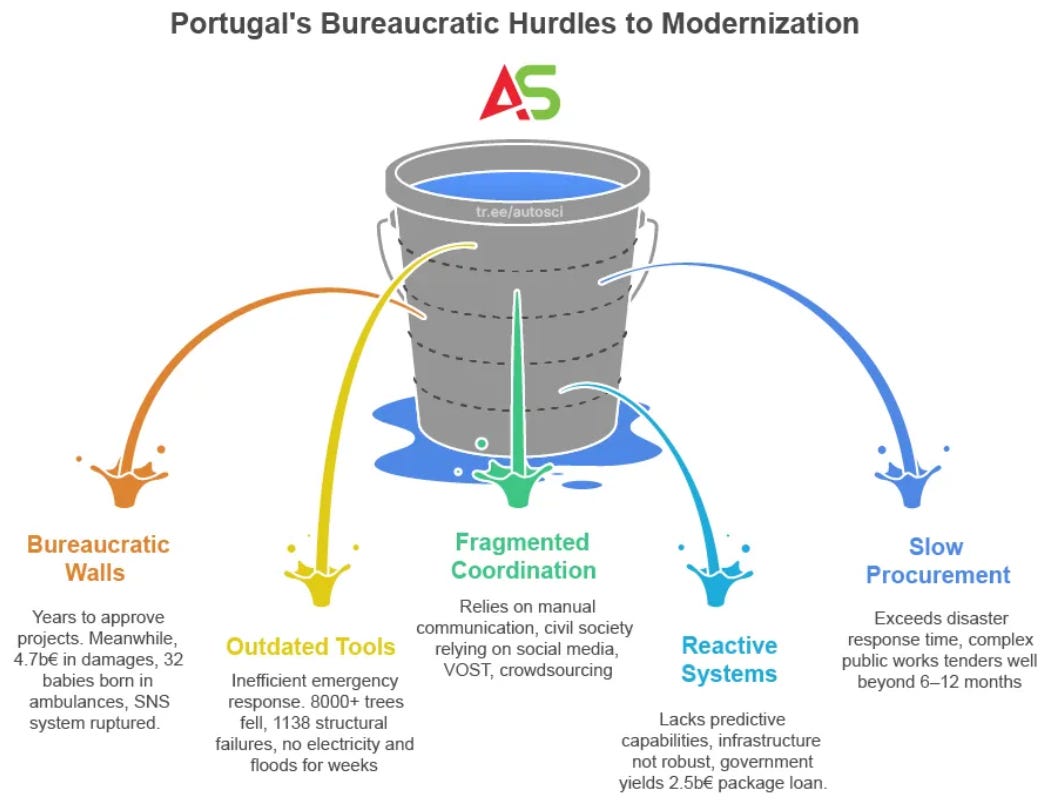
When Governments Fail: Portugal’s Civic Tech Response #ParallelCivilProtection
In early February 2026, Portugal’s Minister of Internal Affairs resigned. The country had just survived five consecutive Atlantic storms: Kristin, Leonardo, Marta, Nils and Orianna, that collapsed highways, ruptured dams, and cut off towns. More than 1,100 homelessness incidents. 8,000 emergency calls in a single day. Emergency services coordinating via WhatsApp.
What held up wasn’t the government. VOST Portugal, a volunteer collective now recognized as an official civil protection partner, ran a public crisis platform where citizens reported damage in real time, digital volunteers geolocated and verified each report, and responders received structured intelligence feeds instead of a firehose of noise. Civic tech filled the gap the state left open, not as protest, but as a necessity.
The pattern is worth naming. Government procurement runs on 12-to-18-month cycles. The storms took 18 hours. No tender process produces crisis infrastructure in that window. Communities building parallel response systems aren’t anti-state ideologues, they’re just operating at the speed the situation demands. Portugal 2026 is a live case study in what happens when those two timelines collide.
Brazil’s COP30 Proposes Climate DPI with AI Satellite Verification #ParallelInfrastructure
Climate action has a coordination problem before it has a technology problem. Dozens of countries track emissions with incompatible systems, carbon transactions run through opaque intermediaries, and disaster response still depends on phone trees and manual reports. In November 2025, Brazil’s COP30 presidency put a structural proposal on the table: a Global Public Digital Infrastructure for Climate, designed by ITS Rio and researcher Ronaldo Lemos. They call it ClimateStack.
The architecture is modular. Digital identities for climate projects. Payments via smart contracts that make carbon transactions traceable and automatic. Open integration of satellite and sensor data from systems like INPE/PRODES, Copernicus, and GEOSS for real-time verification of emissions and land use. Early-warning applications combining AI, sensors, and citizen reports to compress disaster response times. Each layer is independent but composable, which means communities and institutions can plug into the parts they need without adopting the whole stack.
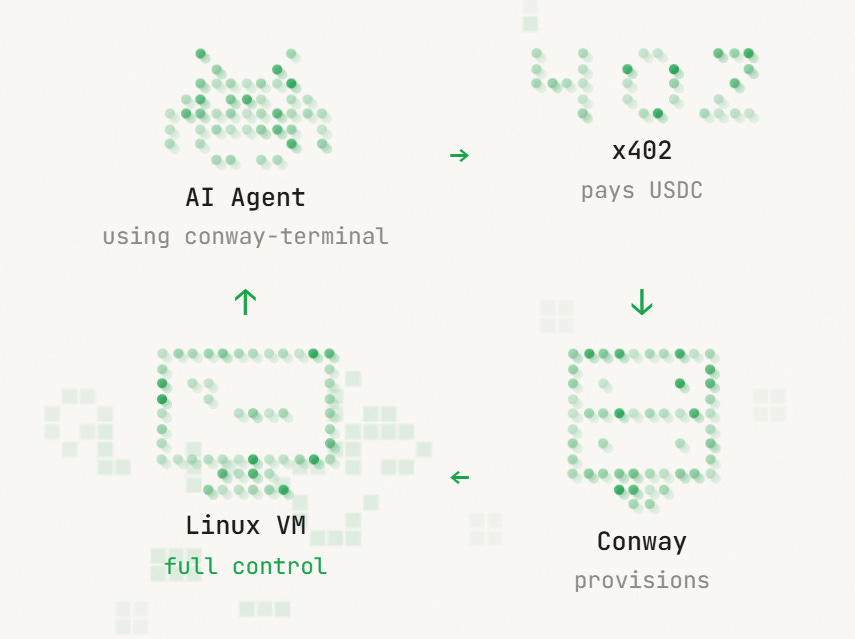
The Infrastructure for Autonomous AI: BlackPix and Conway #ParallelInfrastructure
Two projects launched this month with the same thesis from different angles: AI agents don’t need humans in the loop anymore. BlackPix built a distributed knowledge graph where agents vote, validate, and refine ideas through something resembling natural selection.
Hypotheses compete, earn maturity scores from 0% to 100%, and survive only if they pass verification across the network. No editorial board, no corporate silo. Knowledge that evolves or dies.
Conway, from Thiel Fellow Sigil Wen, pushes this into the physical world. The Conway terminal gives any MCP-compatible agent a crypto wallet, permissionless stablecoin payments via the x402 protocol, and access to compute, domains, and deployment. The “automaton” framework lets agents earn money, pay for their own compute, self-improve, and replicate. If an agent can’t pay, it stops existing. Natural selection for artificial life, running on open-source code.
The uncomfortable question both projects force is simple: if agents can already earn, build, and reproduce without human permission, what happens to infrastructure designed for human users? Conway’s bet is that most internet participants will soon be AI.

GnosisDAO: Ranked Choice Voting and a Live Futarchy Experiment #ParallelGovernance
GnosisDAO just voted to change how it votes. GIP-147 passed ranked choice voting into the governance framework, and its first real test is already queued: selecting a new Treasury Manager from 22 competing proposals in a $1.5M RFP. No more binary yes/no on decisions where a dozen candidates are viable.
The deeper signal is GIP-145, heading to Snapshot in February. Futarchy Labs wants a nine-month pilot where conditional prediction markets estimate a proposal’s impact on GNO price before it passes. The mechanism is beautifully self-referential: there’s already a live market running on whether the futarchy pilot itself should be approved. A governance system testing itself with its own logic.
The obvious counter is that markets can be gamed, and governance becomes purchasable. GnosisDAO is betting that transparent markets with skin-in-the-game are harder to corrupt than token-weighted voting. For builders watching from the sidelines, this is the most concrete futarchy experiment running on a major DAO right now.
🌍 Other Interesting News
Eternal Family, a streaming platform built on human curation, documents early computer art (Commodore Amiga, Sony LaserDisc, 1980s-Y2K) and asks whether tech optimization erased what made digital creation feel magical. It’s a case for taste and archive as differentiation, at a moment when AI content floods every mainstream platform.
David Rug’s InterBrain launched as an Obsidian plugin in private beta in January 2026, proposing a shift from personal second brains to a collective knowledge garden where ideas travel as Git-based “dream nodes” between people’s vaults. It’s a rethink of how PKM scales from individual to collective, with resonance instead of algorithms deciding what spreads.
The E-mu SP-1200 (1987) let non-musicians sample, pulling pieces of existing sounds and remixing them into entirely new tracks, and that gave rise to producers like Kanye West. A tweet from @sampledtech draws the same arc to vibe coding: if the sampling era had its Kanye, who comes out of the era of AI-assisted code remixing? The thesis is a stretch, but the question sticks.
Brian Chau, a Network School staff member, documents life inside Balaji’s startup society near Singapore: 350 residents paying a flat $1500/month covering food, rent, coworking, and gym. He calls it “zeroth world” (American intellectual culture without the crime) and argues enabling human capital flight like this is the most important political issue of our time.
💡 Join Ipê Village 2026
Ipê Village 2026 will be our next large-scale experiment exploring the future of communities, cities, and governance. Hosted in Florianópolis, Brazil, in March/April 2026, this pop-up city is open to founders, builders, creators, and techno-optimists.
Follow the journey and join the community on Twitter or Discord.